2005 Corvette Design: Leaner and More Passionate - GM Press Release
2005 CORVETTE DESIGN: LEANER AND MORE PASSIONATE
For Release: Jan. 1, 2004, 12:01 a.m.
Source: GM Media Archives
The exterior of the 2005 sixth generation Corvette is a modern blend of form, function, and emotion. Corvette combines performance technology with expressive style – attributes central to Corvette's well-established mission.
The C6 propels that foundation into the future with an all-new expression of style that is completely fresh, yet unmistakably "Corvette." In terms of function, Corvette also pushes forward with a body that incorporates state-of-the-art performance technology and sophisticated quality.
Corvette design reflects its serious performance. From the very beginning engineers envisioned that that next Corvette would take a logical step up in performance. That meant a more powerful car that was also more agile, more "placeable" and "tossable" on the race track, while also more comfortable in daily driving and at home in any environment. Distilling the dimensions of C6 into a smaller package would emphasize its potency and the musculature that flexed beneath its tauter surfaces.
An overall length of 174.6 inches (4435 mm) and an overall width of 72.6 inches (1844 mm) were established as the target dimensions. Even though C6 is now 5.1 inches shorter and 1.1 inches narrower than C5, efficient packaging and a wheelbase that is 1.1 inches longer allow C6 to maintain current levels of interior room and class-leading cargo space. And, yes, there is still room for two golf bags.
Reducing two areas of the C6 front-end architecture enabled the overall shortening of the car:
- The front sections of the hydroformed rails were shortened by 2.4 inches (60 mm).
- The fore/aft dimension of the front bumper beam was shortened by .63-inch (16 mm). The previous beam was roll-formed; the new beam is made from two C-channels of high-strength, 180 ksi steel that are seam-welded together.
In the rear, the length was reduced by more effective positioning of energy-absorbing foam and by shortening the rear fascia and bumper structure.
C6's overall dimensions are similar to those of the Porsche 911, another respected performer on the road and track.
A Corvette at 100 yards
The tighter, more athletic dimensions of the car were not only engineering calculations; in the design studio, the concept for a leaner, more passionate Corvette was gaining momentum. In addition, Tom Peters, chief designer of the C6, charged his team with designing a 21st century performance car that would propel Corvette forward, not merely reflect on the car's rich heritage.
"Designing the next Corvette is both every designer's dream and a tremendous challenge," said Peters. "Everybody has their personal vision of what a Corvette should look like. Part of what makes Corvette so successful is its sense of history and heritage. But, in our view Corvette should look forward."
The driving factor behind the exterior design was to keep it as fresh and new as possible, yet distill the passion of Corvette design best exemplified by the classic "mid-year" Corvettes of 1963 through 1967.
"The flair and personality of those older Corvettes have stood the test of time," said Peters. "There are some basic aesthetic attributes that form the foundation of Corvette design which are powerful, pure, and simple."
The following features were identified as essential to Corvette design and were incorporated into C6:
- An expressive front-end "face"
- A tense, flexed look
- Powerful, dramatic arching fender forms
- Side extractors
- Round taillamps and their relationship to the license plate
- Performance-oriented exhaust tips.
"We wanted the C6 to say 'Corvette' at 100 yards," said Dave Hill, chief engineer of the Corvette and vehicle line executive for GM Performance Cars. "But, it achieves this in a way that is unmistakably fresh, new and compelling. This is a design in which the more you look, the more you see."
Design Walk-Around
Egg crate grille heritage
"An expressive 'face' has always been a part of Corvette's image, and C6's new, center-mounted grille continues that tradition," said Peters.
The grille also is necessary as C6 switches from the 100 percent "bottom breathing" air intake of C5 to a hybrid air intake of 60-percent front/40-percent bottom. Its egg crate grille design is reminiscent of Corvettes from both the '50s as well as the mid-year cars – a subtle tribute to Corvette's heritage.
Exposed, HID headlamps
"C6 has exposed headlamps for the first time on a Corvette since 1962, and believe me, there was a lot of emotional discussion around that," said Peters. "We finally settled on exposed headlamps because they fit the theme for the new Corvette – lean, purposeful, performance oriented."
Additionally, fixed headlights offer the advantages of lower weight, less complexity, and superior lighting performance. The C6 utilizes a HID Xenon low-beam projector-beam lens and a tungsten-halogen high-beam projector lens.
The projectors are housed within a polycarbonate enclosure, which also contains the parking lights, side-turn markers, and daytime running lights (DRL) for an integrated appearance. Both lenses are encircled by chrome rings that add a tasteful touch of brightwork, while the bottom of the headlamp assembly, or bezel, is body-colored from the factory, and gives C6 an integrated, upscale look.
In addition to superior lighting performance, the C6 driver gets improved nighttime aerodynamics, appearance and "flash-to-pass" capability.
Bulged hood section
"C6 is packing 400 horsepower under the hood, and we wanted the hood design to reflect that power," said Peters.
The hood's center bulge implies "muscle power" and radiates outward into the front fenders. The cutline for C6's hood opening falls in the valley where the fender meets the hood, Peters pointed out.
"That's a classic sports car styling cue," he said.
Sharp front fenders
"Walking around the front to the side of C6 allows us to appreciate C6's handsome profile," said Peters. "The front fenders are both more rounded and more sharply defined. They're higher by about 10 millimeters and they also feature a beltline crease."
The fenders carry down tight against the wheels and retain more definition as they traverse into the central fuselage. Combined with the shortened front overhang, the fenders contribute to a more taut, purposeful front-end design.
Larger wheels
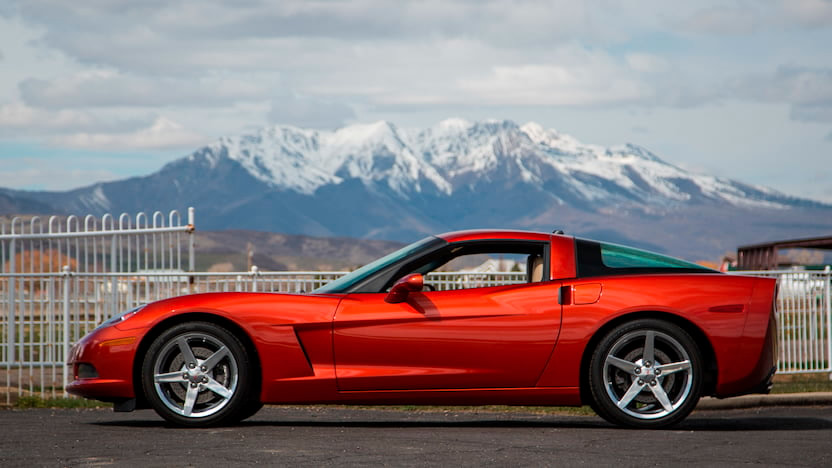
C6 now offers wheels that are 1 inch larger in diameter than C5 as standard: 18.0 x 8.5 inches at the front and 19.0 x 10.0 inches at the rear. The rear wheels are also 0.5 inches wider than C5's. C6 five-spoke flangeless wheels are painted silver as standard; polished aluminum is optional.
Jet fighter profile
C6 continues the Corvette side-profile tradition of a jet-fighter canopy on a fuselage. Viewed from above, the cockpit style of the car has been extended to the roof, with more defined dual blisters.
"We looked to inspiration from modern jet fighters," said Peters. "The side profile brings to mind the silhouette of an F22 Raptor – angular and aggressive, but with just the right amount of curves."
Corvette's new Keyless Access system allows the doors and hatch to operate electronically without exposed handles and key cylinders, allowing the exterior to be free of any visual distraction aside from its own sharply sculpted lines.
Bold rear view
"We paid a lot of attention to designing the rear view of C6," said Peters. "After all, it's the view that most other drivers will see."
The appearance of the rear end was kept bold, simple, and emphasizes the shortened rear overhang.
Round rear lamps
Four round taillamps continue as a Corvette rear styling trademark, a tradition that dates back to 1961 – with variations along the way, such as rounded squares or oval-shaped lights. As one of the key characteristics of Corvette identified early on, round taillamps and their relationship to the license plate were an important styling cue for C6. Reflector optics give the illuminated taillamps a glow reminiscent of jet afterburners.
Accommodating license plate holder
The plate holder enables a more integrated rear-end appearance for C6 when it travels abroad and projects an image of being at home wherever it might be. The holder readily accommodates three different plate sizes: the long, narrow rectangular license plates of the United Kingdom and Europe; the taller, wider license plates of Japan; and the short, rectangular license plates of North America.
Crisp roof and decklid
"On the coupe the fender shapes emphasize crisper transitions and creases that run all the way to the back of the decklid and draw the eye to the taut body form," said Peters.
A center high-mounted stoplight (CHMSL) is integrated into the molded black spoiler located on the rear decklid. The CHMSL is lit using light emitting diodes (LED), as was the lamp on the C5.
Diffused rear fascia
"We wanted to enhance the effect of the skin of the car being drawn down more tightly to the body and also reduce the visual weight of the rear end," said Peters. "So we added a diffuser to the bottom of the rear fascia to enhance air flow and to add visual interest to the rear of C6."
Four circular exhaust tips are integrated into the rear diffuser. The tips exit from the center of the diffuser and pick up the circular theme established by the four round taillamps. Framing the rear fascia with the black CHMSL, functional spoiler at the top and the black diffuser at the bottom produces a narrower cross section. In this way, the rear of C6 is reduced both dimensionally and visually.
Expressive exterior colors
The 2005 C6 will be offered in eight exterior colors:
- Precision Red (new)
- Daytona Sunset Orange (new)
- Le Mans Blue
- Millennium Yellow
- Magnetic Red
- Machine Silver
- Arctic White
- Black
Easier interfaces
All of the major user interfaces – the hood, the doors, and the hatch – have been improved for ease of operation. Doing so improves perceived quality and sets the stage for more favorable impressions behind the wheel.
Easier operating hood
The hood is still forward-hinged, but is 15 percent smaller, 35 percent lighter, and 40 percent stiffer. Closing efforts were reduced while closing energy increases by 50 percent. The result? A hood that latches securely from a single position – the driver no longer needs to run to the opposite side in order to check or secure the hood latch.
Reduced effort hatch
Hatch-closing efforts were reduced thanks to the optimization of locations for hinges, gas struts, and bumper stops. A power-operated single-cinching latch makes sure the hatch seals securely every time it is closed. To make closing more convenient, a hand-hold is designed into the hatch's inside bottom edge. Protected from the elements, the hand-hold stays clean and, to the relief of fastidious Corvette owners everywhere, and prevents fingerprints from collecting on the edge of the hatch.
Doors - Keyless Access with Push Button Start
There are no traditional door handles on the 2005 Corvette. Instead, it features the Keyless Access with Push Button Start system, which replaces traditional door and hatch mechanics with solenoids and electronic actuators. External handles and key tumblers are replaced by membrane-activated switches tucked into a pocket behind each door. The door edge is protected by a small black molding, keeping the finish fingerprint- and scratch-free.
By detecting the proximity of the key fob, the system both unlocks the car doors and allows it to be started. With the key fob in a pocket or purse, one can simply approach the car and touch the pad located on each door and the door unlocks and unlatches. The ignition is operated via a rocker switch located on the instrument panel. As long as the fob is somewhere inside the cockpit and the brake or clutch is depressed, the engine starts at the touch of the button.
Open-air motoring
The removable-roof panel is 15 percent larger, yet offers the same structural stiffness as C5's and weighs just 1 pound more. The roof panel is available painted body-color as standard, optional tinted clear, or with a dual-roof package. With new indexing side-window glass and redesigned seals, the roof panel system also contributes to a quieter interior. The simple three-lever release system makes the panel easier to remove, and the snap-in storage system makes it easier to stow. Small items, bags or briefcases can now be stored underneath the panel when it is stowed.
Improved aerodynamics
The opening to the air is larger and Corvette now moves through the air more easily, too. Thanks to more than 400 hours in the wind tunnel, the shape of the exterior has been optimized for a drag coefficient of .28. It's an impressively low number, and even more so when you consider the C6 has a larger engine with greater cooling needs; shorter front and rear overhangs; an overall length that is 5.1 inches shorter; and has wider rear tires, all of which conspire to make reducing drag difficult.
With a targeted top speed of 180 mph, reducing lift and increasing stability was a critical job in the car's development. That's where the aero experience gained from Corvette Racing's C5-R championship-winning efforts paid huge dividends. With C5-R basically an extension of the "street" car, its race and product development teams communicate constantly, and knowledge gained in one program often crosses over into the other. Aero work, thermal analysis, and tire development are among the most fertile areas of transfer between these two "worlds" of Corvette.